



A growing number of people are asking questions to Google, ChatGPT, Claude and other AI systems, and so the number of brands that want to be present in those answers, when it can help their business, is growing too.
In English there’s a saying: “follow the eyeballs” — invest where you have the best chances of reaching your customers.
AIO, GEO and AEO: what are they?
The umbrella term for the practices aimed at making it easier to appear in AI answers is often called AIO (Artificial Intelligence Optimization), with GEO (Generative Engine Optimization) and AEO (Answer Engine Optimization) as its “subsets”.
(A necessary note: these definitions are still evolving, with conflicting opinions on the meaning and scope of each acronym.)
How did they become important?
It starts with the “SEO crisis” (Search Engine Optimization).
In a study published in June 2026 by SparkToro, based on Similarweb data collected between January and April 2026, it emerged that 63.4% of Google searches in Italy end in “zero clicks” (or taps): for the remaining share, out of 1,000 searches only 280 continue on to a web resource that isn’t a Google resource (AI Mode, YouTube, Google Maps, etc.). What’s more: that figure also includes clicks on advertising, again mediated by Google.
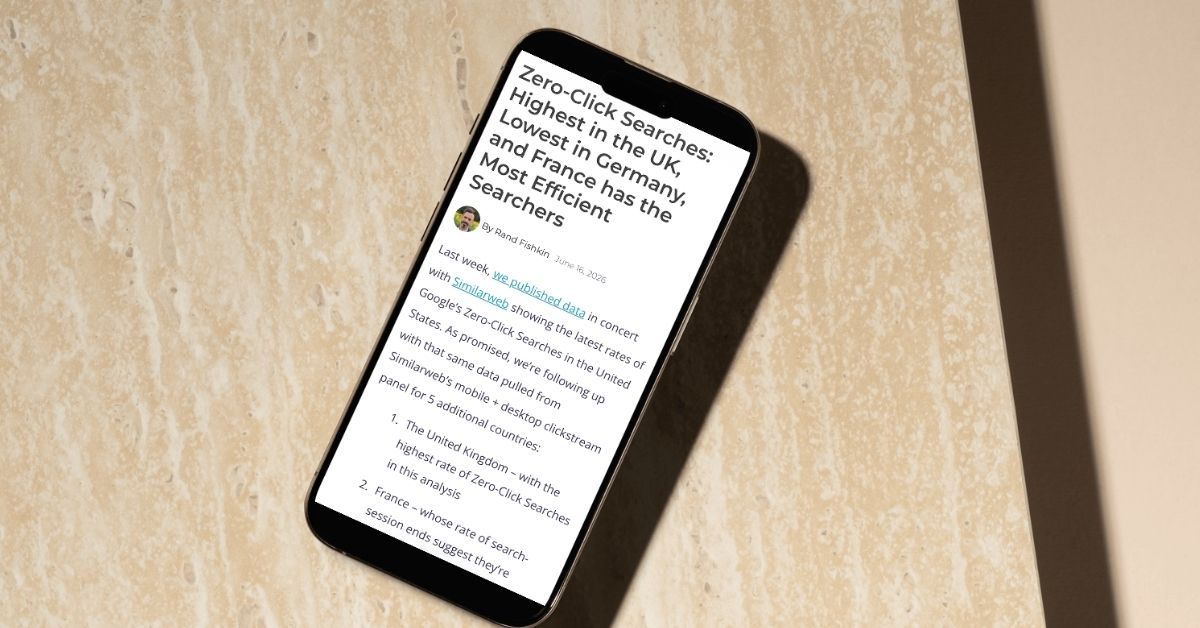
SEO, which has always been focused on optimizing the ranking of a resource on search engine results pages, is affected by this scenario: if the bulk of searches “stop earlier”, its “direct” value shrinks too.
Let’s avoid yet another announcement about the death of this discipline, though: its principles and techniques can be readily reused to ensure that a brand is discoverable by Claude, ChatGPT and the like, and that it appears relevant in relation to specific interests.
AI systems, however, are increasingly one of the starting points for searches, as shown by a recent study by Fractl and Search Engine Land covering 1 million keywords in relation to the US market: tutorials, health, product comparisons, recipes and legal questions are among the types of searches for which people most often turn to AI first and then, if needed, move on to traditional search engines.
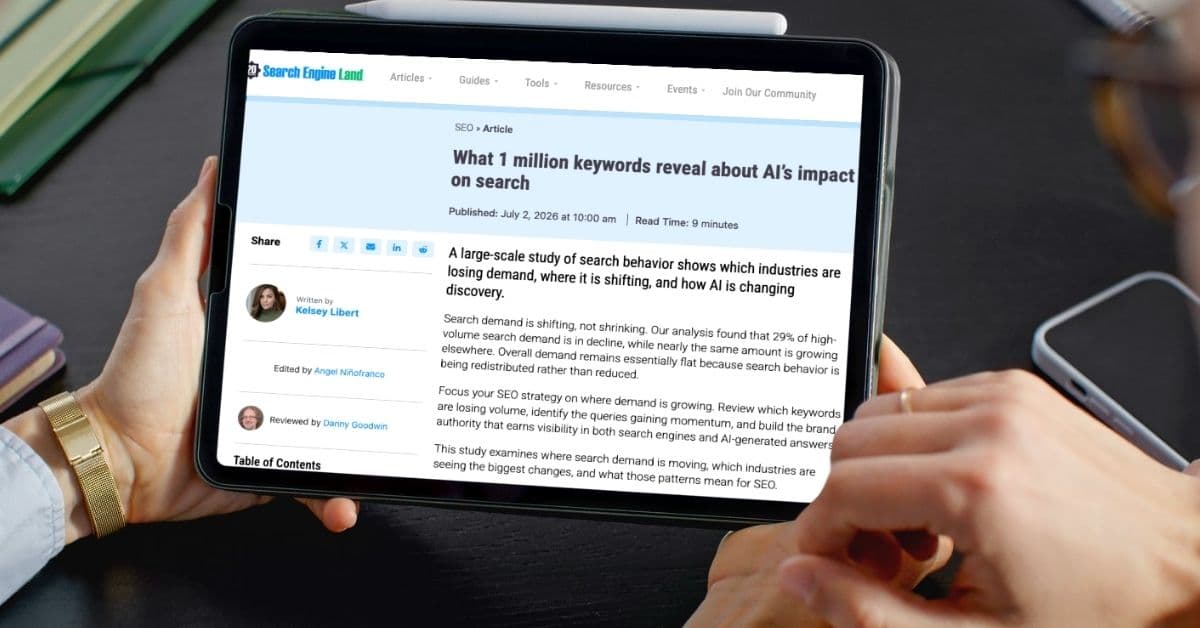
The same report also shows that 59% of consumers visit a brand’s website after it is mentioned in an AI chatbot.
On top of this, one last interesting data point: Gen Z and Millennials are 2.5 times more likely than baby boomers to make a purchase based on an unverified AI recommendation (20% versus 7%). Looking ahead, this signals a shift that will become increasingly relevant in the years to come.
In this scenario, what role does Brand Journalism play?
Brand journalism — that is, the application of journalistic techniques to telling a company’s story — allows a brand to communicate with the market through a clear and recognizable voice, deeply human and able to start and strengthen conversations.
All of this is increasingly picked up and appreciated by artificial intelligence systems, which are now able to filter out what is known as “AI Slop” — low-value content generated by other AI systems — in order to identify and surface authoritative voices, backed by multiple concordant signals of their value.
Let’s focus on that last aspect, the “multiple concordant signals”: a “widespread” presence across the web is highly valued, with recent content that reports verifiable facts (but also statements and testimonials) authored by writers who meet the requirements summarized by Google under the acronym E-E-A-T: Experience, Expertise, Authoritativeness and Trustworthiness.
Brand journalism activities, combined with the techniques of first SEO and now AIO (GEO and AEO), make it possible to communicate with both people and AI through content capable of increasing a brand’s circulation (brand awareness) while strengthening its value (brand equity): beyond the brand’s own assets (owned media), putting good brand journalism practices into action offers more chances to gain widespread, free visibility (earned media) — knowing that, besides people, AI is watching too.
The heart of the value: the human footprint
In a world of AI, even AI itself looks for the human footprint, becoming ever better at recognizing its signals, beyond tricks and shortcuts.
We humans are doing the same thing: the “noise” generated by so much low-quality AI content is increasingly pushing us to seek out authentic, human voices with which to build “real” connections (a semi-quote, for those who remember it 😉).
Of course, in brand journalism too, the techniques used to optimize effort and maximize results matter — but today, more than ever, a brand’s ability to make people “feel” the humans behind it is what makes the difference.
At Axura we help companies tell their own story: we’ve been doing it for years with method, expertise and passion, including through brand journalism, together with our clients.
Want to know more? Visit our website for further information.

